Skip to content

Explore Apprenticeship Programs

Leverage Registered Apprenticeship Programs With the United States Department of Labor

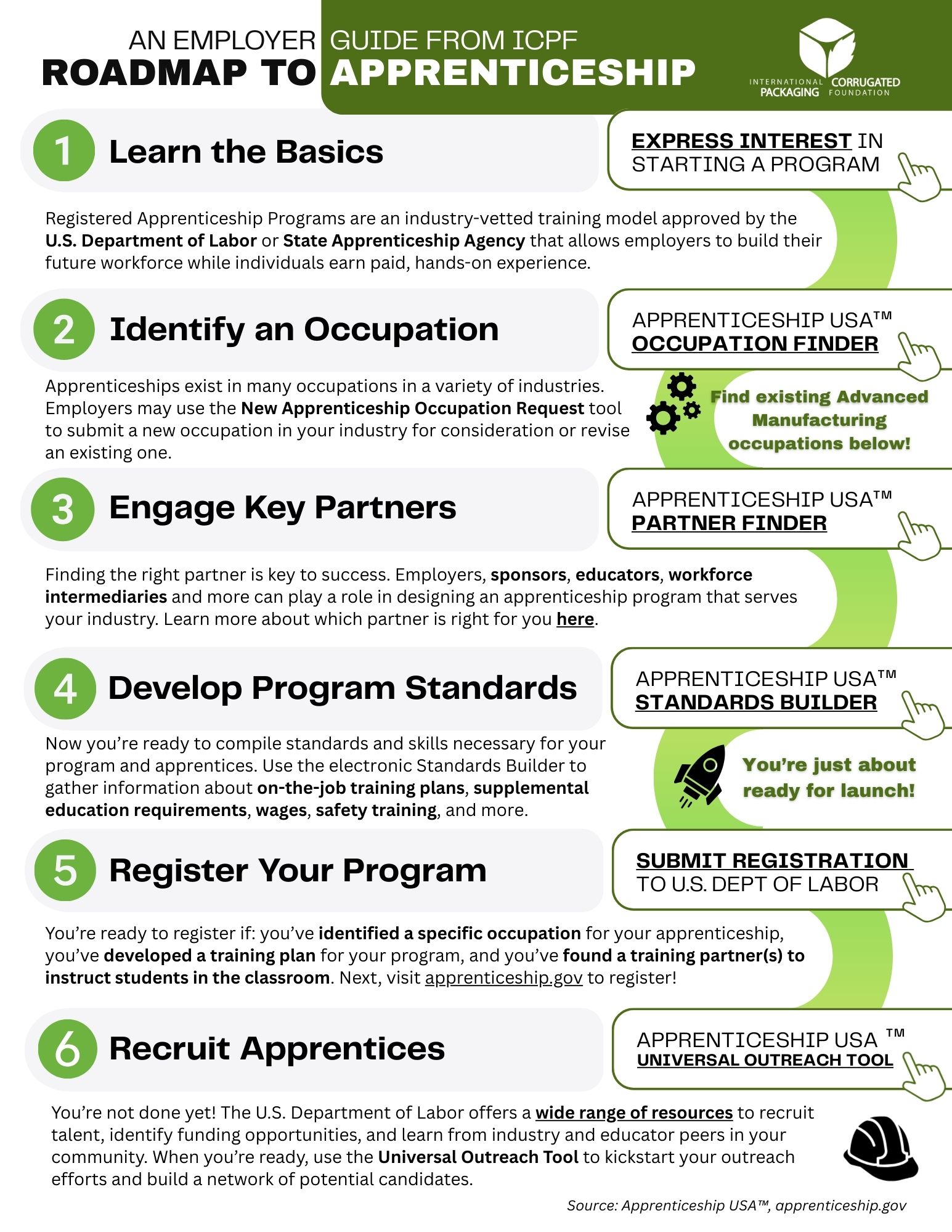
Registered Apprenticeship is an industry-driven, high-quality career pathway where employers can develop their future workforce while individuals can find paid work experience and receive a nationally-recognized credential.  Registered Apprenticeships are industry-vetted and approved by the U.S. Department of Labor or a State Apprenticeship Agency. Apprentices who are trained via non-traditional routes can add value to your business, increase productivity, reduce turnover, and foster employee retention. Apprenticeship USA provides valuable resources to help you join an existing program, create one of your own, or simply learn more about what these programs and candidates have to offer.

Design an apprenticeship that works for your plant.

Start by identifying the corrugated packaging roles that are the hardest to hire or train, such as machine operators or maintenance technicians. With guidance from federal and state apprenticeship experts, employers define the skills, on-the-job training, mentorship structure, and classroom instruction needed to develop a highly skilled employee over time. Training partners like community colleges or technical schools can support related instruction while employers maintain control over job standards and outcomes.

Turn your training model into a nationally recognized credential.

Once your apprenticeship structure is defined, employers are ready to formally register the program through the U.S. Department of Labor of their State Apprenticeship agency. Registration ensures your program meets national quality standards and allows apprentices to earn a portable, industry-recognized credential upon completion. Registration also unlocks access to technical assistance, workforce partners, and in many states, financial incentives or support.

Foster a reliable pipeline of future employees.

With a registered apprenticeship in place, employers can recruit candidates through high schools, trade and technical schools, community colleges, workforce boards, and veteran organizations. Employers can rely on outreach tools available through the USDOL or tap into their surrounding communities. Apprentices are hired as employees from day one and earn wages while learning on the job. Ongoing mentorship, clear advancement pathways, and progressive wage increases help improve retention and performance.

What is a registered apprenticeship?

Registered Apprenticeship (RA) is an industry-vetted training model approved by the U.S. Department of Labor or a State Apprenticeship Agency that allows employers to build their future workforce while individuals earn paid, hands-on experience. Programs are developed by industry and formally validated by federal and state agencies to ensure training aligns with real workforce needs. A Registered Apprenticeship should meet the following criteria:

  • Industry Led: Programs and industry-driven to align with industry standards and ensure that apprentices are trained for highly skilled, high-demand occupations.
  • Paid Job: Apprentices earn progressive wages as their skills and productivity increase.
  • Structured On-the-Job Learning/Mentorship: Programs provide structured on-the-job training to prepare for a successful career, which includes instruction from an experienced mentor.
  • Supplemental Education: Apprentices are provided supplemental classroom education based on the program standards and employer’s training needs.
  • Credentials: Apprentices earn a portable, nationally-recognized credential within their industry.
  • Quality & Safety: Apprentices are afforded worker protections while receiving necessary training to equip them with the skills and supervision they need to be safe in a manufacturing environment.
  • Apprenticeships are an Equal Employment Opportunity.
What are the benefits of an apprenticeship for employers?

There are many proven benefits to apprenticeship programs for employers and workers alike:

  • Recruit and develop a highly-skilled workforce
  • Improve productivity and positively impact your bottom line
  • Minimize cost through reduced turnover
  • Create flexible training options that ensure workers are equipped with the right skills
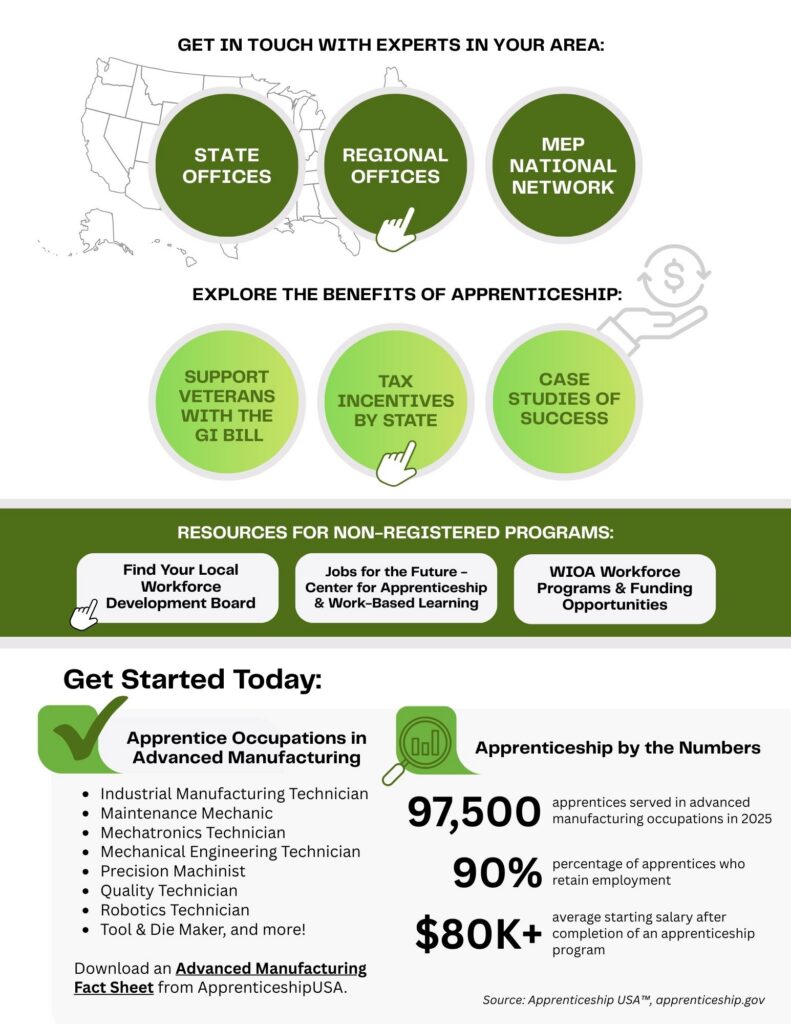
  • 90% of apprentices continue employment after completing an apprenticeship
  • Demonstrate investment in your community and instill company culture

In addition to these overarching benefits, pursuing a Registered Apprenticeship (RA) Program through the U.S. Department of Labor yields the following advantages:

  • Gain access to a nationwide network of expertise, customer service, and support.
  • Graduates receive a national, industry-recognized credential.
  • RA Programs meet national standards for quality and rigor.
  • In many states, business can qualify for tax credits.
  • Federal programs supply funding and other resources.
  • Recruiting incentives exist for apprentices, most notably veterans who qualify for GI Bill benefits.
Who should I partner with?

Successful apprenticeships require key partners to help design, develop, and deliver your program. These partners may include apprenticeship offices, sponsors, educators, intermediaries, workforce development boards, and more. As an employer, it is important to identify educators and sponsors who can play a role in providing instruction to students and operating the program.

According to the U.S. Department of Labor, an educator (i.e. 4-year college, community college, trade or technical school) delivers academic and skills instruction driven by industry standards, which requires instructors, curriculum and instructional equipment. In an apprenticeship, the education and training provider can also grant progressive credentials based on competency testing, facilitate access to financial aid and supports, and identify potential apprentices. A sponsor is any person, association, committee, or organization that assumes full responsibility for the administration and operation of a Registered Apprenticeship Program. Sponsors can be a single business, consortium of businesses, labor-management association, or community-based organization, to name a few.

Consider using Apprenticeship USA’s Partner Finder and get connected with the right partners to team up with your organization.

Can I join an existing program?

Yes. Interested participants can use the Partner Finder to search for existing programs in a specific location by occupation or by industry. Simply enter your search criteria and select “I want to join an existing program” to get started. From there, you’ll find available program details and contact information to get in touch with organizations and RA Programs operating in your area.

How do I get started?

Employers who are interested in taking steps to create or join a Registered Apprenticeship program can visit the U.S. Department of Labor website to complete an Express Interest form. Once you’ve answered a few simple questions, you’ll be connected with an apprenticeship consultant to walk you through the appropriate steps. More information and relevant case studies can also be found here to inform the best path forward for your manufacturing facility.

What are my options for a non-registered apprenticeship?

Non-registered apprenticeships are employer-driven training programs that combine on-the-job learning with industry-specific instruction, but lack formal approval from the U.S. Department of Labor or state apprenticeship agencies. Unlike Registered Apprenticeship, these programs allow employers greater flexibility in structure and duration, but do not guarantee a portable, nationally-recognized credential for graduates.


Strengthen Your Workforce With the Manufacturing Skills Institute (MSI)

Consider strengthening your box plant workforce with the Manufacturing Skills Institute’s (MSI) registered apprenticeship program. MSI provides industry certifications and solutions through industry, academic, and workforce partnerships across the nation. MSI offers 8 apprenticeship programs with grant funding, tailored to advance your new and existing employees and meet your business needs while supplementing your existing training. MSI can also help offset costs if you have a currently running apprenticeship program. Contact Wes Smith, Director of Workforce Solutions at [email protected] to conduct a needs analysis or learn more.